by Edith Olasanya | Jul 8, 2026 | Brand Strategy & Marketing
Okay, I need to get something off my chest.
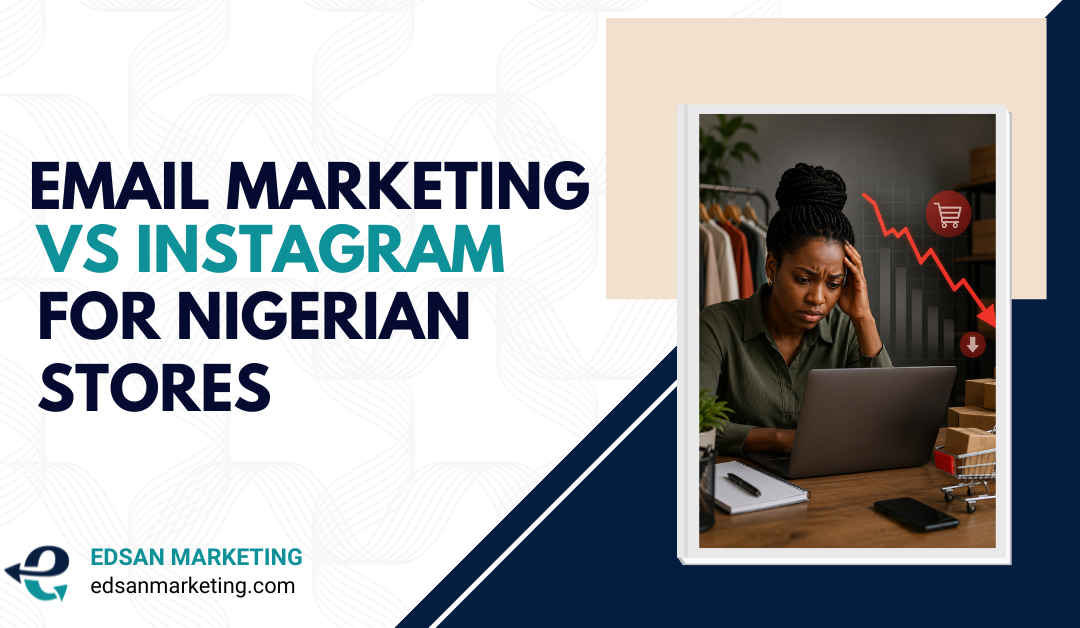
If you sell online in Nigeria, you already know this feeling. Someone lands on your store. They scroll through your photos a little too long for it to be nothing. They read the caption twice.
Maybe they even put something in their cart.
And then something else grabs their attention, or their data finishes, or their baby starts crying, or honestly, who knows. They just leave.
Here’s the part that never stops getting to me, even after years of doing this: there’s nothing the brand can do about it in that moment. No name. No number.
Money was spent that the business really couldn’t spare getting that person to the page, and they walked away for free, with no way to ever speak to them again.
Most founders take it personally. I get it it feels like something you did wrong. But it’s rarely about the product or the content. It’s that the channels doing all the work were never built to let you follow up.
We’re So Good at Getting Attention.
Can we just appreciate, for a second, how creative Nigerian sellers are?
The Reels, the trending sounds, the “abeg no scroll” captions are genuinely gifted at getting eyes on their stuff. Nobody has to teach Nigerian sellers to hustle.
But here’s what most founders don’t realise until it’s too late: Instagram was never really theirs. Every brand I work with is building on land it doesn’t own.
Your followers belong to Instagram. And when it decides to change the rules, restrict an account, throttle reach, a brand finds out in the worst possible way exactly how little control it actually had.
I’ve watched this happen to brand after brand, and I don’t want it to happen to yours.
Email Marketing? SMEs Roll Their Eyes At First. Here’s Why They Shouldn’t.
I’ll be honest with you, almost every business owner I say this to gives me the same look. Email? That’s for big brands abroad, not for a Nigerian store selling bags and skincare on Instagram. I get it.
But stay with me, because it’s not what you’re picturing.
It’s not a boring monthly newsletter nobody opens. Think of it this way: posting on Instagram means putting something out there and hoping the algorithm decides to show it to enough people.
Email is nothing like that. You write the message once, and then it sends itself, to exactly the right person, at exactly the right moment, without asking anyone’s permission first.
Someone kept staring at that same dress? Email quietly asks, “still thinking about it?” Someone filled a cart and vanished? An hour later, an email nudges them: “You left something behind.”
A customer who used to buy from you every month suddenly goes quiet? Email reaches out and says, gently, “We miss you.”
All of that. While you’re asleep. While you’re at the market sourcing stock. While you’re living your life. The system just keeps working.
Let’s Talk About Instagram, Honestly
I still love Instagram. I’m not here to tell you to abandon it. But I need you to see it clearly, because a lot of business owners don’t, until it’s too late.
You post something you’re proud of, and it goes out to a fraction of your followers. Not because they don’t care. Because the algorithm decided they didn’t need to see it that day.
Out of 5,000 followers, maybe a few hundred actually see any single post, if you’re lucky. The rest scroll straight past without ever knowing it existed.
That’s a gut punch every time you realise it. All that work, and most of their own audience never even sees it.
Email doesn’t play that game. When you hit send, it goes to every person on your list. No algorithm quietly deciding who deserves to see it. No paying extra to “boost” your own message to your own customers.
And then there’s the fear that sits at the back of every Nigerian seller’s mind: the Instagram ban.
Accounts get restricted or disabled, sometimes with no explanation at all, and every follower a brand spent months building goes silent overnight.
I’ve watched it happen to people I know, and it’s devastating to watch a business lose everything it built, overnight.
Your email list can’t be taken from you like that. It’s yours. Nobody can switch it off because they changed a policy somewhere in California.
So keep posting on Instagram; it’s still one of the best ways for new people to discover you.
Just don’t mistake it for something that was ever built to be reliable.
It was built to keep people scrolling, not to keep you paid.
What About Just Running More Ads?
I get asked this a lot, so let’s just talk about it directly.
Ads work. I run them for clients constantly: Instagram ads, TikTok, Facebook boosts. They’re genuinely one of the best ways to get new eyes on a store, and I’m not telling anyone to stop.
But ads and email aren’t solving the same problem, and it’s a distinction a lot of founders miss.
Every naira you spend on an ad buys you someone’s attention once. The moment your budget stops, so does the traffic. There’s no residue, no leftover reach sitting there for free. If that person didn’t buy the first time, you’ll probably have to pay again just to get back in front of them.
Email is the opposite. The moment someone joins your list, however they got there, an ad, a referral, a random Instagram comment, you’ve paid for that relationship once. After that, reaching them again costs you almost nothing. You could email that same person ten times over the next year for a fraction of what one more ad would cost.
Ads get people through the door. Email is what happens once they’re actually inside your house.
If you’re pouring money into ads every month with nothing catching the people who don’t buy immediately, you are every single time paying full price for every single sale.
Email is what finally lets you stop doing that. If you want the deeper walkthrough of exactly how this plays out in real revenue, I wrote the full breakdown here: how to increase email revenue
The 3 Emails Every Nigerian Online Store Needs
This is where most brands think it’s complicated, but it really isn’t.
You don’t need 30 emails. You don’t need to write something new every day. You start with three.
1. The Welcome Email
When someone joins your email list, they’re at the peak of their interest in your brand.
This is the moment to say hello, tell your story, and make them feel good about signing up.
A welcome email typically goes out automatically the moment someone subscribes.
It might include a small incentive a discount, free shipping, early access to new collections.
And it sets the tone for everything that follows. Most Nigerian stores skip this entirely.
Their new subscriber signs up and hears nothing for weeks. By then, they’ve forgotten who you are.
2. The Abandoned Cart Email
This one might be the most important of all. Imagine someone spends 15 minutes on your store.
They fall in love with a ₦45,000 bag. They add it to their cart.
And then their phone rings, or NEPA strikes, or they just need to think about it, and they leave.
Without email marketing, that sale is gone forever. With an abandoned cart email, they get a gentle nudge about an hour later:
“You left something behind.” Sometimes that’s all it takes.
The sale comes back. This happens across every kind of product fashion, skincare, home goods, electronics.
People get distracted. They don’t always mean to leave. And a well-timed reminder brings a lot of them back.
3. The Win-Back Email
For customers who bought from you before but haven’t returned in a while, this email says: we noticed you’ve been quiet, and we’d love to see you again.
It’s not pushy. It’s just a reminder that you’re still here, you still care, and there might be something new worth checking out.
A lot of brands focus so hard on finding new customers that they forget about the ones they already have.
But selling to someone who already bought from you once is far easier than convincing a stranger to trust you for the first time.
What Your Customers Are Already Telling You
Here’s something that surprised me when I first got into email marketing: your customers communicate through their actions, not their words.
When someone browses the same product three times, they’re saying “I want this, I’m just not sure yet.”
When someone abandons a cart worth ₦60,000, they’re saying “I was this close.”
When a loyal customer suddenly stops buying for two months, they’re saying “I need a reason to come back.”
Email marketing lets you respond to these signals automatically. You’re not guessing.
You’re listening to what your customers’ behaviour is already telling you and responding with the right message at the right moment.
That’s not just smart marketing.
That’s just good customer service, with a little automation behind it.
“But I Don’t Have Many Subscribers Yet”
I hear this constantly, and I want to be honest with you about it.
You do not need thousands of people to start. You don’t need a beautiful, polished template.
You don’t need any of the things that feel intimidating right now.
What you actually need is smaller than you think. A simple way for people to sign up is a small popup offering 10% off or free delivery is enough.
Your three core emails, written once, run quietly forever after that. And a simple update once a week or two, not spam, just something worth their time from a brand they already said yes to.
Fifty people who actually open your emails is a real start. A hundred is a real list. It grows from there, and it gets stronger the longer you let it run.
Why Now Is Actually the Right Time for Nigerian Brands
Here’s something worth knowing: email marketing in Nigeria is still early.
Most Nigerian ecommerce brands are still entirely dependent on Instagram and WhatsApp.
The brands that build email lists, even small ones, are building an asset their competitors don’t have.
Five years from now, the stores that are thriving will be the ones that have built relationships directly with their customers.
Not just followers. Not just broadcast list contacts.
Actual, owned relationships. The window to be an early mover is open right now.
Want to Know Where Your Store Stands?
At EDSAN Marketing, we offer a free email audit for Nigerian ecommerce brands.
We’ll look at what you currently have set up or what you’re missing entirely and tell you exactly what to fix first for the fastest results.
It takes about 20 minutes, and you’ll walk away with a clear picture of what’s possible.
No pressure, no obligation. Just a clear conversation about your store.
To book your free audit, send an email to info@edsanmarketing.com with the subject line: “I want my free audit.”
We’ll be in touch within 24 hours.

by Edith Olasanya | Jun 18, 2026 | Brand Strategy & Marketing
The Reason Your Marketing Isn’t Working Probably Isn’t Your Marketing
You have successfully tested various advertising creatives. You confidently switched agencies to find the best fit. This year alone, you have revamped your homepage three times, ensuring it effectively represents your brand.
You’re posting on LinkedIn, sending emails, running campaigns, and the numbers still feel like pushing water uphill.
The problem usually isn’t the marketing. It’s what’s underneath it.
Most businesses are not under-marketing.
They are under-positioned.
The message they’re putting into the world is unclear, generic, or interchangeable with five other businesses doing roughly the same thing.
And no amount of beautiful ad creative can rescue a message that fails the first test of marketing: can someone tell, in one sentence, why they should pick you over the alternative?
This is a brand positioning problem.
And until you fix it, every marketing dollar you spend works at 30% of its potential.
This guide gives you the 5-question framework to diagnose and rebuild your positioning whether you’re a service business, an e-commerce brand, or a founder launching something new.
What Brand Positioning Actually Is (And What It Isn’t)
Positioning gets confused with branding, marketing, and messaging constantly.
Let’s draw the line clearly.
Brand positioning is:
The deliberate choice of who you’re for, what problem you solve, what makes you different, and what you want to be remembered for is captured in language that’s simple enough for a stranger to repeat back to you.
Brand positioning is not:
- Your logo
- Your colour palette
- Your tagline
- Your social media aesthetic
- A list of services on your website
Those are expressions of positioning, not positioning itself.
A clean logo on top of confused positioning is still confused positioning just in a nicer font.
The simplest test: a brand with strong positioning can finish this sentence without hesitation “We help [specific audience] achieve [specific outcome] without [specific frustration], using [specific approach].”
If you can’t finish that sentence, or it sounds like every competitor’s version, positioning is your bottleneck not your ads, not your content, not your sales calls.
3 Symptoms Every Under-Positioned Business Recognises
Before the framework, here’s how to know positioning is the actual problem.
Symptom 1 — Your ads underperform regardless of creative.
You test new images, new copy, new offers. Click-through rates stay flat.
Cost per lead stays high.
That’s the signal that the message itself isn’t landing not that the visuals are off.
Symptom 2 — Sales calls get stuck on “what do you actually do?”
If prospects need a 20-minute explanation before they understand your offer, your positioning is doing the work that should already have happened on your homepage.
Strong positioning shortens the sales cycle because the buyer arrives half-sold.
Symptom 3 — Referrals describe you differently than you describe yourself.
Ask three existing clients to describe what you do in one sentence.
If they give three different answers, you don’t have positioning, you have noise.
Worse, the noise is multiplying every time someone refers you.
If two or more of these sound familiar, positioning is the highest-leverage fix you can make this quarter.
The 5-Question Brand Positioning Framework
This is the framework we use with clients at EDSAN.
Answer all five honestly and you’ll come out with positioning that’s sharper than 90% of competitors in your space.
Question 1 — Who exactly do you serve?
Most businesses answer this with breadth: “
We serve small businesses.”
Or worse:
“We work with anyone who needs our service.”
Breadth is the enemy of positioning.
The narrower you can describe your ideal customer, the more powerfully your message will land including, paradoxically, with people outside that narrow definition.
Weak answer:
“We help businesses grow.”
Strong answer:
“We help fashion e-commerce brands doing $500k–$5m in annual revenue scale email marketing without hiring an in-house team.”
The strong version eliminates 95% of the market.
That’s the point. The 5% who fit are now 10× more likely to choose you.
Question 2 — What problem do you solve that no one else solves the same way?
This is the question most businesses skip.
They describe what they do (the service) instead of the problem they solve (the customer’s pain).
Customers don’t buy services.
They buy outcomes.
And they buy outcomes from the business that names the problem most precisely.
Weak answer:
“We do email marketing.”
Strong answer:
“We turn cold email lists into predictable monthly revenue, so founders stop relying on ad spend to hit their numbers.”
The second version names the real pain (ad dependency) and the real outcome (predictable revenue).
The service is the means, not the message.
Question 3 — What do you stand for that competitors don’t?
This is your point of view.
Your hill.
The thing you say loudly that the rest of your industry won’t.
Strong positioning is always a little bit controversial because to stand for something, you have to be willing to stand against something else.
Weak answer:
“We believe in quality service and great results.”
Strong answer:
“We believe most agencies are vendors, not partners and that you should fire any agency that won’t show you their dashboard.”
The strong version creates a category.
Customers who agree are now 5× more loyal.
Customers who don’t agree weren’t going to buy from you anyway.
Question 4 — What’s the proof?
Positioning without proof is just claims.
Strong positioning anchors its difference in something concrete case studies, data, certifications, partnerships, methodology, or measurable client outcomes.
Weak proof:
“Trusted by hundreds of clients.”
Strong proof:
“Klaviyo Partner. 30–60% added monthly email revenue for fashion e-commerce brands. Case studies available on request.”
Specificity reads as credibility. Vagueness reads as marketing.
Question 5 — What’s the one thing you want them to remember?
If a customer can only remember one sentence about your business 30 days from now, what is it?
This is your positioning statement.
It should be short enough to repeat at a dinner party, specific enough to differentiate, and emotional enough to stick.
Weak:
“We do marketing for small businesses.”
Strong:
“We’re the email engine for fashion brands ready to grow without burning more on ads.”
The strong version is sticky because it names the who, the what, and the why in twelve words.
How to Test If Your Positioning Is Working: The 3-Person Test
After you’ve answered all five questions, run this test before you commit:
- Send your positioning statement (Question 5) to three people who know your business: a client, a peer, and someone outside your industry.
- Ask each of them to describe what you do in their own words, the next day, without re-reading the statement.
- If all three describe you similarly, your positioning works.
- If you get three different answers, the statement is too vague or too clever rewrite and retest.
This is the cheapest, most honest brand research you can run.
It catches problems no internal team will catch, because the people inside your business already know what you mean.
Real Examples: Weak vs Strong Positioning
These are not specific brands, they’re composite examples drawn from common patterns we see in audits.
Weak (Skincare brand):
“Premium skincare for radiant, healthy skin.”
Strong (Skincare brand):
“Skincare for women over 40 who want results without 12-step routines or ingredient confusion. Made in small batches, tested on humans.”
The strong version named the audience (women over 40), the specific frustration (complicated routines), the proof point (small batches, human-tested), and a point of view (against the 12-step trend).
Weak (Service business — accountant):
“Trusted accounting services for small businesses.”
Strong (Service business — accountant):
“We help creative agency owners read their numbers in 10 minutes a month so they spend the rest of the time running the business, not decoding spreadsheets.”
The strong version positioned around an audience (creative agency owners), a frustration (time spent on numbers), and a clear outcome (10 minutes a month).
Weak (Coach):
“Helping leaders unlock their potential through transformational coaching.”
Strong (Coach):
“I help newly promoted directors at mid-sized tech companies stop being managers and start being leaders in 90 days, without the corporate retreat clichés.”
Same coaching service.
But the strong version is bookable.
The weak version is invisible.
How Strong Positioning Cuts Your Marketing Costs
Here’s the part most founders miss: positioning is not just a brand exercise. It’s a cost exercise.
When positioning is sharp:
- Your ads need less creative testing to find what works
- Your sales calls shorten because prospects arrive pre-qualified
- Your email open rates climb because the audience self-selected
- Your content goes further because each piece reinforces the same point
- Your team stops disagreeing about who you’re for
Look at the difference between a fashion brand with strong positioning (“the everyday minimalist label for women 30+”) and one with weak positioning (“modern apparel for the contemporary woman”).
The first runs a Klaviyo welcome flow that converts 14%.
The second runs the same flow and converts 4%.
Same Klaviyo.
Same offer.
Different positioning underneath.Positioning is the multiplier on every marketing system you’ll ever build.
5 Positioning Mistakes That Quietly Kill Marketing Performance
Mistake 1 — Positioning around the product, not the customer.
“We sell premium leather bags” is product-led.
“We make bags for women who hate replacing them every two years” is customer-led.
The second outsells the first every time.
Mistake 2 — Trying to serve everyone.
Every business that tries to serve “anyone” ends up speaking to no one.
Narrow positioning expands your real market broad positioning shrinks it.
Mistake 3 — Confusing positioning with branding.
You can have beautiful branding and broken positioning.
You cannot have strong positioning and weak marketing.
Positioning comes first.
Mistake 4 — Changing positioning every six months.
Positioning needs at least 18–24 months to compound in the market.
If you rewrite it after every slow quarter, no one ever has time to remember it
.Mistake 5 — Borrowing positioning from a bigger competitor.
The position that worked for Apple, Nike, or Glossier worked because they got there first.
Borrowing it makes you a footnote in their story.
Your positioning needs to come from your customer, not their press release.
Frequently Asked Questions
How often should I revisit my brand positioning?
Every 18–24 months at minimum, or whenever you significantly shift your audience, expand into new services, or notice the 3 symptoms in this guide. Positioning should be stable enough to compound but reviewed often enough to stay accurate.
Can a small business actually compete on positioning?
Small businesses win on positioning. Large brands have to position broadly to serve broad markets. Small businesses can position narrowly, claim a specific niche, and dominate it — long before a bigger competitor notices the category exists.
Is positioning the same as a value proposition?
Closely related, but not identical. Positioning is the strategic decision — who you’re for, what you stand for, what makes you different. Value proposition is the expression of that positioning in customer-facing language. You need both, but positioning comes first.
How long does it take to develop strong positioning?
A focused positioning sprint takes 2–4 weeks. The bigger time investment is testing it in market — landing pages, ads, sales calls — for 60–90 days to see if it lands. Most businesses don’t fail at developing positioning; they fail at committing to it long enough to compound.
Do I need an agency to position my brand?
Not always. The 5-question framework above is usable by any founder willing to be honest. An external partner helps because positioning requires saying no to audiences and services you’ve been holding onto for years — and that’s easier with someone whose job isn’t to make you feel comfortable.
How do I know if my positioning is “working”?
Three signals: shorter sales cycles, better referral language (customers describe you the
The Bottom Line
Most businesses scale marketing before they scale clarity.
They run ads on top of unclear positioning, hire teams to write content for unclear messaging, and rebuild websites that say the same vague thing in nicer typefaces.
Then they wonder why the numbers don’t move.
The fix isn’t more marketing. It’s a clearer positioning.
Answer the five questions.
Run the 3-person test.
Commit to it for 18 months.
Then watch how every marketing dollar you spend starts working harder, not because the marketing got better, but because the message underneath finally became something worth marketing.
If you’d like a free 30-minute Brand & Marketing Positioning Audit, we’ll walk through your current positioning, identify the gaps, and show you the three highest-leverage moves to sharpen it — book a strategy call here.