

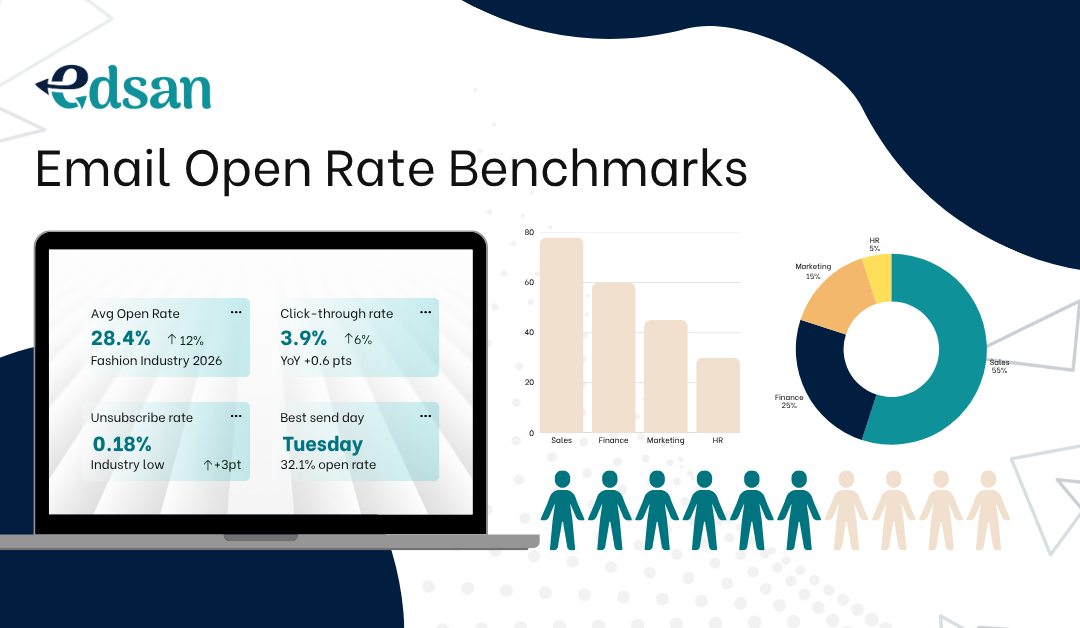
Email Open Rate Benchmarks for Fashion Stores in 2026
How You Compare & What to Do About It
You’ve spent hours crafting the perfect email campaign for your fashion store. You hit send.
And then… silence. Your open rate is 18%. You’re thrilled. Then you wonder: Is that actually good? Or are fashion brands supposed to be hitting 25%? 35%? How do you know if you’re winning or falling behind?
The truth is, email open rates are one of the most misunderstood metrics in fashion e-commerce. Brands obsess over them, yet most don’t know what constitutes a “good” open rate for their specific industry and email type. In this guide, we’re breaking down 2026 email open rate benchmarks specifically for fashion stores—so you know exactly how you stack up against competitors and what you can actually do to improve.
What Are Email Open Rate Benchmarks?
Email open rate = (Number of emails opened ÷ Number of emails delivered) × 100
An open rate of 20% means that 1 in 5 people who received your email actually opened it.
Benchmark = Average performance data across thousands of similar businesses.
When you compare your 18% open rate to the fashion industry average of 22%, you immediately know you’re performing 18% below average, and there’s room to improve. That’s the power of benchmarks—they give you context.
Why Open Rates Matter (But Aren’t Everything)
Open rates are important because they tell you whether your subject line is compelling.
A weak subject line = low open rate = fewer people reading your message. But here’s what most brands get wrong: High open rates alone don’t determine revenue.
A 25% open rate with weak email copy and no compelling CTA will generate fewer sales than a 20% open rate where every person who opens actually wants what you’re selling.
Translation: Focus on open rates, yes—but obsess over click-through rates and conversions too.
Email Open Rate Benchmarks for Fashion Brands (2026)
Based on 2026 industry data from major email platforms, here’s what fashion stores are actually achieving:
By Email Type
| Email Type | Average | Good | Excellent |
|---|---|---|---|
| Welcome | 35-45% | 45-55% | 55%+ |
| Promotional | 18-22% | 22-28% | 28%+ |
| Abandoned Cart | 20-25% | 25-35% | 35%+ |
| Post-Purchase | 28-35% | 35-42% | 42%+ |
| Re-engagement | 15-20% | 20-28% | 28%+ |
| VIP/Loyalty | 30-40% | 40-50% | 50%+ |
What this means: If your regular promotional emails are hitting 22%, you’re right at industry average. If they’re at 18%, you’re underperforming—but you have clear room to improve.
Why Fashion Open Rates Are Lower Than Other Industries
Fashion retail has some of the most competitive email environments. Why?
- Email Frequency: Fashion brands send more often than other industries
- High Saturation: Customers get daily emails from dozens of fashion brands
- FOMO Marketing: Everyone’s using urgency (“48-hour flash sale!”) so nothing feels urgent anymore
- Seasonal Variations: Open rates drop during holidays (everyone’s inbox is full)
- Mobile-Heavy Audience: Fashion audiences are younger, email on mobile, and have a higher likelihood of previewing without fully opening
Translation: Fashion stores face a harder challenge than B2B companies or other industries.
A 22% open rate for a promo email is solid—not because it’s high, but because it’s actually competitive in a saturated market.
Here’s what doesn’t make it into most benchmark reports:
The Hidden Truth About Email Benchmarks
1. Benchmarks Don’t Account for Email Frequency
A brand sending 2 emails per week will have different open rates than one sending daily emails. Benchmarks average across all brands, so they hide this reality.
What to do: If you’re sending promotional emails daily, expect lower open rates than a brand sending 2x weekly. That’s normal.
2. Benchmarks Don’t Reflect Segmentation Quality
A brand that sends the same email to 100,000 people will have lower open rates than a brand that segments and sends targeted emails to 20,000 people.
Example:
- Unsegmented campaign to 100,000: 18% open rate
- Segmented campaign to 20,000 (new customers only): 35% open rate
What to do:
Segment your audience. Open rates improve dramatically when you target the right people.
3. Benchmarks Don’t Distinguish Between List Quality
A brand with a purchased email list will have low open rates. A brand that organically grew an engaged list will have high open rates. Benchmarks don’t tell you this.
What to do:
Build your email list organically. An engaged 10,000-person list beats a purchased 100,000-person list every time.
How Fashion Stores Actually Compare
To give you real-world context, here’s what we’re seeing from fashion brands:
Below-Average Performance (< 18%)
Typical cause: Weak subject lines, poor list quality, sending to unengaged subscribers
Example: Sending the same “Summer Sale” email to your entire list daily for a week
Fix required: Segment + personalize + test subject lines
Average Performance (18-22%)
What it means: You’re competitive but not winning. Typical cause: Consistent email efforts but basic segmentation
Example: Sending weekly promotional emails to your main list
Opportunity: Segment by purchase history, test subject lines, optimize send time
Above-Average Performance (22-28%)
What it means: You’re outperforming most competitors . Typical cause: Strong list quality, good subject lines, basic segmentation
Example: Segmenting by product category + personalized subject lines
Edge case: You’re doing something right—figure out what and double down
Excellent Performance (28%+)
What it means: You’re in the top tier
Typical cause: Sophisticated segmentation, dynamic content, engaged audience
Example: VIP segment getting exclusive content, automated welcome sequences, high-frequency engagement campaigns
Reality check: This usually requires dedicated email marketing resources or an agency
Why Your Open Rates Matter Less Than You Think
Here’s the uncomfortable truth: Your competitors are also focused on open rates. Which means they’re all playing the same game: writing clever subject lines, testing send times, and watching their open rate. But the real money is in the metrics below open rates:
Click-Through Rate (CTR)
How many people who opened your email actually clicked your link?
- Average CTR: 2-5%
- Top performers: 8-15%
Bottom line:
If you improve CTR from 3% to 5%, you’ve just increased campaign revenue by 67% (same open rate, more conversions).
How many people who clicked actually bought?
- Average conversion rate: 2-4%
- Top performers: 6-12%
Bottom line: If you improve conversion rate from 2% to 5%, you’ve tripled revenue without changing open rates.
Translation:
A 20% open rate with strong copy, clear CTAs, and a high conversion rate beats a 28% open rate with weak conversion any day.
How to Improve Your Email Open Rates (7 Proven Tactics)
Now that you understand benchmarks, here’s how to actually move the needle:
Tactic 1: Segment by Purchase History
The principle: New customers need different messaging than repeat buyers.
What we see:
- New customers: Average 35-40% open rate (they’re engaged, recently subscribed)
- Repeat customers: Average 22-28% open rate (fatigue sets in)
- Inactive customers: Average 8-15% open rate (haven’t bought in 6+ months)
Implementation:
Create separate email campaigns:
- New customers: Frequent, friendly, educational
- Repeat customers: Exclusive offers, loyalty rewards
- Inactive: Win-back campaigns with special incentives
Result: Open rates increase 15-25% when you segment by purchase history.
Tactic 2: Optimize Subject Lines (Test, Test, Test)
A subject line is the only thing subscribers see before deciding to open or delete. It’s critical.
What works for fashion brands:
- Personalization: “Sarah, your style awaits” (35% open rate)
- Curiosity: “We found 3 pieces you’ll love” (32% open rate)
- Benefit-driven: “Get 20% off—today only” (28% open rate)
- FOMO (sparingly): “Only 2 left in your size” (30% open rate)
What doesn’t work:
- All caps: “HUGE SALE NOW LIVE” (18% open rate)
- Overused urgency: “Last chance!” (for the 5th time this week) (15% open rate)
- Generic: “Update from [Brand Name]” (12% open rate)
How to test:
Use A/B testing to send two versions to small segments, see which wins, then send the winner to your full list. Klaviyo makes this easy with built-in A/B testing.
Result: Proper subject line testing improves open rates 5-10%.
Tactic 3: Optimize Send Time
When you send matters. A LOT.
Fashion store data (2026):
- Best time to send: Tuesday-Thursday, 10 am-2 pm in the recipient’s timezone
- Worst time: Monday morning (everyone’s overwhelmed), Friday afternoon (decision fatigue)
- Mobile considerations: Fashion audiences check email 3x most between 12 pm-1 pm (lunch break).
The catch: This varies by audience. Fashion brands selling to Gen Z see peak opens at 7-9pm (evening browsing). Fashion brands selling to older demographics peak at 11am.
Implementation:
- Analyze your own data first (use Klaviyo analytics)
- See when YOUR audience opens emails
- Test different send times
- Use timezone sending (Klaviyo feature) to optimize for each recipient’s local time
Result: Proper send time optimization improves open rates 5-8%.
Tactic 4: Clean Your Email List Regularly
A bloated list with lots of inactive subscribers tanks your open rate. Here’s why: Email platforms measure your reputation based on engagement. If 50% of your list never opens, you get flagged as low-quality. Your emails land in spam more often. Open rates drop.
How to fix it:
- Identify inactive subscribers (no opens in 6 months)
- Send a re-engagement campaign (“We miss you! Come back for 15% off”)
- Remove anyone who doesn’t engage from that campaign
- Your list is smaller, but your open rate increases 15-25%
Counterintuitive fact:
Removing 10,000 inactive subscribers and increasing from 18% to 25% open rate is better than keeping 10,000 inactive subscribers at 18% open rate. Perception matters to email platforms
Result:
List cleaning improves open rates 10-20%.
Tactic 5: Build Deeper Segmentation
We mentioned segmentation, but here’s how deep you can really go:
Example segments for a fashion store:
- New subscribers (welcome sequence)
- Product category interest (e.g., “Women’s Dresses” openers vs “Accessories” openers)
- Price sensitivity (buy at full price vs coupon hunters)
- Frequency preference (frequent emailers vs preference for weekly digests)
- Lifecycle stage (first purchase, repeat, loyal, dormant)
Each segment gets targeted messaging. Open rates increase dramatically.
Example:
Sending one email to “All Subscribers” = 20% open rate. Sending five targeted emails to five segments = 25%, 28%, 32%, 22%, 18% average = 25% overall (but with much better segment experience).
Result:
Proper segmentation improves open rates 8-15%.
Tactic 6: Create a Welcome Sequence (Your Secret Weapon)
Welcome emails are the holy grail. They have the highest open rates because subscribers
just signed up—they’re paying attention.
Benchmarks for fashion:
• Email 1 (immediate): 45-55% open rate
• Email 2 (day 2): 35-42% open rate
• Email 3 (day 5): 30-38% open rate
What a good welcome sequence does:
• Sets expectations (“We email 2x per week”)
• Gives immediate value (10-20% first purchase discount)
• Educates (who you are, what you sell)
• Builds trust (social proof, reviews)
Result:
A solid welcome sequence sets the tone for your entire email relationship and improves lifetime email engagement by 30-40%.
Tactic 7: A/B Test Everything (But Not All at Once)
The brands with the highest open rates don’t rely on benchmarks. They test.
What to test:
- Subject lines (week 1)
- Send time (week 2)
- Sender name (week 3)
- Preview text (week 4)Important: Test one variable at a time. If you test the subject line AND send time together, you won’t know which one caused the improvement.
Result:
Continuous testing improves open rates 2-5% per month.
Fashion Store Email Open Rate Benchmarks in Context
Let’s bring this full circle. You now know:
- Fashion industry average open rate for promo emails: 22%
- Your brand’s current rate: 18%
- That means you’re 18% below average, not catastrophically underperforming
- You have clear opportunities to improve
Your Action Plan
- Segment by purchase history (5-10 minute setup, 15% improvement)
- Test 3 subject lines (1 hour testing, 5-10% improvement)
- Optimize send time (1 hour analysis, 5-8% improvement)
- Clean your list (remove inactive, 1-2 hour process, 10-20% improvement)
Realistic result: In 30 days, you could move from 18% to 24-26%—above industry average, firmly competitive.
The Real Question: Should You Care About Open Rates?
Yes—but with context. Monitor open rates because they indicate:
- Subject line quality
- List health
- Audience engagement level
- Email deliverability issues
Conclusion:
Use Benchmarks as a Starting Point, Not an Endpoint
Email open rate benchmarks give you a baseline. For fashion stores, that baseline is around 22% for promotional emails.
But your real competitive advantage isn’t in matching benchmarks—it’s in understanding what drives open rates at your brand, then relentlessly optimising those variables.
Frequently Asked Questions
22-28% for promotional emails, 35-45% for welcome sequences. Above 28% means you’re outperforming the industry.
Usually one of five reasons: weak subject lines, poor send timing, unengaged audience, low list quality, or not segmenting. The fix is specific to your situation.
Gradual decline (22% → 20% over 6 months) is normal list fatigue and growth. Sharp decline (22% → 15% in 1 month) indicates a problem—usually deliverability or major list quality issue. Investigate immediately.
Quarterly. Benchmarks shift seasonally (lower in Nov-Dec due to inbox saturation, higher in Jan-Mar when people are less active). Track your own data monthly, compare to industry benchmarks quarterly.
SMS doesn’t have “open rates” in the traditional sense—everyone gets the message. Instead, track click-through rate and conversion rate, which are typically 5-15x higher than email.