How You Actually Compare in 2026 (And Why Old Benchmarks Are Lying to You)
You sent a promo email to your fashion store list. Open rate: 18%.
You check a “2026 benchmark” article, and it says the industry average is 22%. You panic.
You assume you’re underperforming.
Here’s the problem: most benchmark articles published in 2026 are quoting numbers from 2019.
They haven’t been updated for Apple Mail Privacy Protection (MPP), Gmail’s image proxying, the rise of automated flows, or the actual data Klaviyo released for the apparel category.
This guide uses the latest 2026 data from Klaviyo’s benchmark report (built on 183,000+ ecommerce brands), Litmus’s email analytics, and live industry reporting so you know what “good” actually looks like right now, and where to focus your effort.
What Is a Good Fashion Email Open Rate Benchmark in 2026?
Benchmarks (2026)
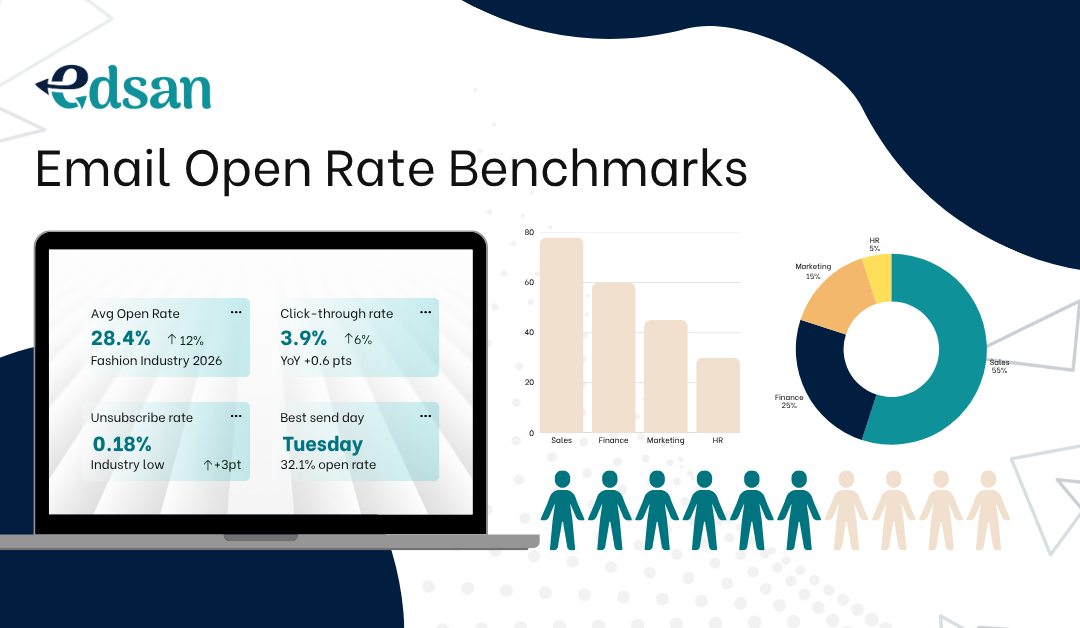
Based on Klaviyo’s 2026 benchmark report and verified across multiple data sources, here’s what fashion and apparel ecommerce brands are actually achieving today.
Campaign Open Rates by Email Type (Fashion & Apparel)
Important context: These are reported open rates. Apple Mail Privacy Protection (MPP) inflates these numbers by 15–20 percentage points across the board because it pre-fetches tracking pixels for ~49% of all opens (Litmus, 2026).
Your real engaged-human open rate is closer to 20–28% on a promo email that reports 32%.
| Email Type | Below Average | Average | Good | Excellent |
|---|---|---|---|---|
| Welcome Flow (Email 1) | < 45% | 50–55% | 55–65% | 65%+ |
| Promotional Campaign | < 28% | 30–34% | 35–42% | 42%+ |
| Abandoned Cart | < 45% | 50–53% | 55–65% | 65%+ |
| Browse Abandonment | < 40% | 45–50% | 50–58% | 58%+ |
| Post-Purchase | < 40% | 45–52% | 52–60% | 60%+ |
| Re-engagement / Win-back | < 18% | 22–28% | 28–35% | 35%+ |
| VIP / Loyalty | < 40% | 45–55% | 55–65% | 65%+ |
Why the Old “22% Open Rate” Number Is Wrong
Many fashion marketing guides still quote 18–22% as the promotional benchmark.
This number came from pre-2021 data, before three structural shifts:
- Apple Mail Privacy Protection (Sept 2021): Apple now pre-fetches every email image, registering an “open” whether or not the recipient saw the message. ~58% of all email opens now flow through Apple Mail.
- Klaviyo’s market dominance in ecommerce: Klaviyo’s dataset is 4× larger and more apparel-weighted than the legacy Mailchimp benchmarks most articles still cite.
- The flow vs campaign split: Open rates on automated flows (welcome, cart, browse) are now structurally far higher than batch campaigns. Averaging them together hides the real story.
The corrected 2026 fashion campaign benchmark is 30–34%, not 22%.
If you’re hitting 18%, you’re not “just below average.” You’re significantly underperforming and have major room to improve.
The Metric That Actually Matters Now: Click Rate & Click-to-Open Rate
Because MPP has compromised open rates, sophisticated email teams have shifted their primary KPI to click rate and click-to-open rate (CTOR), both of which are immune to MPP inflation.
Fashion & Apparel Click Rate Benchmarks (2026)
| Email Type | Below Average | Average | Good | Excellent |
|---|---|---|---|---|
| Promotional Campaign | < 0.5% | 0.8–1.2% | 1.5–2.5% | 2.5%+ |
| Welcome Flow | < 3% | 4–6% | 7–10% | 10%+ |
| Abandoned Cart | < 4% | 5–7% | 7–10% | 10%+ |
| Browse Abandonment | < 2% | 3–5% | 5–8% | 8%+ |
| Post-Purchase | < 2% | 3–5% | 5–7% | 7%+ |
Key insight from Klaviyo’s 2026 data: Fashion & apparel has the lowest campaign click-through rate of any ecommerce vertical (~0.98%).
This is not a failure; it’s structural.
Fashion audiences are inundated with daily promo emails, and most just scan visuals.
Your job is to beat fashion-specific CTR benchmarks, not generic e-commerce ones.
The Biggest Untold Story in 2026
Here is the single most important statistic in fashion email marketing right now, and it seldom appears in benchmark articles:
In 2026, automated email flows generated 41% of total email revenue from just 5.3% of email sends.
Revenue per email for flows is $2.87 vs $0.18 for batch campaigns a 16× difference. (Source: Klaviyo 2026 Benchmark Report)
Translation: if you’re a fashion brand spending all your energy on the weekly promo blast, you are leaving 80%+ of your revenue on the table.
The leverage is in flows: welcome, browse abandonment, abandoned cart, post-purchase, and win-back.
What this means for benchmarking: Stop measuring yourself only on campaign open rates. Start measuring:
- Flow open rates (should be 45–65%+ across the board for fashion)
- Flow click rates (should be 4–10%+ depending on type)
- Revenue per recipient (RPR) the single best KPI in 2026
Why Fashion Ecommerce Has Distinct Benchmarks
Fashion sits in a unique benchmark category for four reasons:
1. Visual category, high preview engagement.
Subject lines compete with hero images that often render in preview panes — meaning subject line tweaks have less leverage in fashion than in services or SaaS.
2. Mobile-first audience.
Over 65% of fashion email opens happen on mobile devices (Litmus 2026).
Subject lines must work at 35–40 characters; longer ones get truncated.
3. Daily promo saturation.
The average fashion subscriber is on 14+ brand lists.
This is why fashion CTRs are structurally lower than the ecommerce average, not because your copy is bad.
4. Promotions tab placement.
Gmail’s Promotions tab catches most fashion promo emails.
Brands that move flows (welcome, cart) to Primary inbox see open rates jump 8–15 points.
How to Read Your Open Rate in 2026
Instead of asking “Am I at 22% or 28%?” ask these four questions:
1. What’s my real (non-MPP) open rate?
Subtract ~15–20 percentage points from your reported number for an estimate of true engaged opens.
If you reported 32% and your Apple Mail share is 60%, your real open rate is closer to 22%.
2. What’s my click rate?
This is the only opens-adjacent metric that is honest.
If your campaign CTR is below 0.8%, fix this before touching subject lines.
3. What’s my conversion rate per send?
Multiply opens × clicks × purchase rate.
Fashion benchmark for promo campaigns: 0.05–0.15% of sends convert to purchase.
For abandoned cart flows: 2.5–5%.4.
What’s my revenue per recipient (RPR)? For campaigns: $0.10–$0.30 = average; $0.30–$0.70 = good; $0.70+ = excellent.
For abandoned cart flows, $3.00–$8.00 per recipient is the apparel norm.
Why Your Fashion Emails Aren’t Getting Opened
Tactic 1: Invest in Flows Before Campaigns
If you don’t have these four flows running with at least 4 emails in each, build them this week:
- Welcome series (5 emails over 14 days)
- Browse abandonment (3 emails over 48 hours)
- Abandoned cart (4 emails over 4 days)
- Post-purchase / cross-sell (4 emails over 30 days)
Expected lift: 25–40% of total email revenue, even at modest list size.
Tactic 2: Optimise for the Primary Inbox
Promo emails land in Gmail’s Promotions tab. Flow emails land in Primary if formatted right.
- Strip excessive imagery from flow emails (text-forward design)
- Avoid HTML tables in welcome emails
- Use a recognisable sender name (a person’s name beats a brand name in fashion: “Sarah from [Brand]”)
Expected lift: 8–15 points on flow open rates.
Tactic 3: Segment by Engagement Recency, Not Just Purchase History
In 2026, the strongest segment is “engaged in last 30 days” who opened or clicked anything.
Send most of your volume to this segment.
- 0–30 day engagers: full send schedule
- 30–90 day engagers: 50% of send volume, more curated
- 90–180 day engagers: re-engagement flow only
- 180+ day: sunset (remove from active list)
Expected lift: 12–25% on reported open rate; 30%+ on click rate.
Tactic 4: Write Subject Lines for Mobile First
Mobile cuts subject lines at 35–40 characters. Front-load the hook.
Works in fashion (2026):
- “Sarah, your size just restocked” first-name personalisation + scarcity
- “The dress 3,400 women bought this week” social proof + curiosity
- “Sneakers worth waiting for” soft curiosity, no urgency cliché
- “20% off but only your category” relevance over volume
Stop using:
- ALL CAPS subject lines (now mostly filtered to spam)
- Generic “last chance” open rate has collapsed for this phrasing
- Emoji-stuffed lines (3+ emoji reduces opens in apparel by ~6%)
Tactic 5: Use Send-Time Optimisation (Not Guesswork)
The 2019 advice “send Tuesday 10 am” is outdated.
Today, you should be using Klaviyo Smart Send Time or send-time AI in your ESP.
It sends to each recipient at the time they’re most likely to open.
Expected lift: 5–9 points on opens, 2–4 points on clicks.
If you must batch-send: best windows for fashion in 2026 are Tuesday/Wednesday 11 am–1 pm and Sunday 6–8 pm (evening browsing).
Worst windows are Monday 8–10 am and Friday 4–6 pm.
Tactic 6: Clean Your List Aggressively
Your sender reputation in Gmail and Outlook is driven by engagement rate, not list size.
Remove anyone who hasn’t engaged in 180 days.
A 20,000-person list with a 35% open rate beats a 100,000-person list with a 15% open rate every time, for revenue and deliverability.
Expected lift: 10–20 points on reported open rate; ~3× improvement in inbox placement.
Tactic 7: Build a Smart Re-engagement Flow Before You Sunset
Before removing inactive subscribers, run a 3-email win-back flow:
- Email 1: “Did we lose you? Soft re-engagement, no offer
- Email 2: “Here’s 15% off; we’d love you back incentive
- Email 3: “Last email, confirm you want to stay subscribed” explicit opt-in
Anyone who doesn’t click in this sequence gets removed.
This is a deliverability hygiene step, not a marketing one.
Tactic 8 A/B Test Click-Through, Not Just Opens
Because MPP has destroyed the validity of A/B testing on open rate, only test using click rate or conversion as the success metric.
Test in this order:
- Email content & CTA (highest impact)
- Hero image
- Subject line (yes, last; its impact has diminished)
- Send time
- Sender name
Frequently Asked Questions
For reported open rates: 30–34% on promo campaigns is average; 35–42% is good; 42%+ is excellent. But adjust your expectations down by 15–20 points if you want the “real” engaged-human number, because Apple Mail Privacy Protection inflates opens.
Yes, but only as a directional signal, not a primary KPI. Use them to spot subject line problems and deliverability issues. Use click rate and revenue per recipient as your primary KPIs in 2026.
MPP pre-fetches email images for ~49% of all tracked opens, inflating reported open rates by 15–20 percentage points. In Apple-heavy audiences (US, UK, fashion-skewing demos), up to 60% of “opens” can be artificial. This is the single biggest reason old benchmarks no longer apply.
Because fashion has the lowest CTRs in ecommerce structurally. Klaviyo’s 2026 data puts apparel & accessories campaign CTRs at ~0.98%. Compare yourself to fashion-specific benchmarks, not generic ecommerce ones.
Flows. Klaviyo’s 2026 data shows flows generate 41% of email revenue from just 5.3% of sends a 16× revenue-per-email advantage. If you have to choose, build your welcome, browse, cart, and post-purchase flows before sending another campaign.
Twice a year. Klaviyo, Litmus, and Omnisend publish updated apparel benchmarks each February and August. The market shifts faster than annual reports can capture.
The Bottom Line
The 2026 email landscape for fashion has changed more in the last 18 months than in the previous five years.
Apple MPP has broken the open rate as a clean metric.
Klaviyo’s flow-driven data has redefined what “good” looks like.
And fashion’s saturation problem makes generic e-commerce benchmarks misleading.
Stop chasing a 22% open rate that came from a 2019 report.
Build the flows, clean the list, segment by engagement, and measure click rate and RPR.
The fashion brands winning in 2026 stopped optimising for opens 18 months ago they optimised for revenue per recipient. You can too.